Endogenous Technological Change Along the Demographic Transition
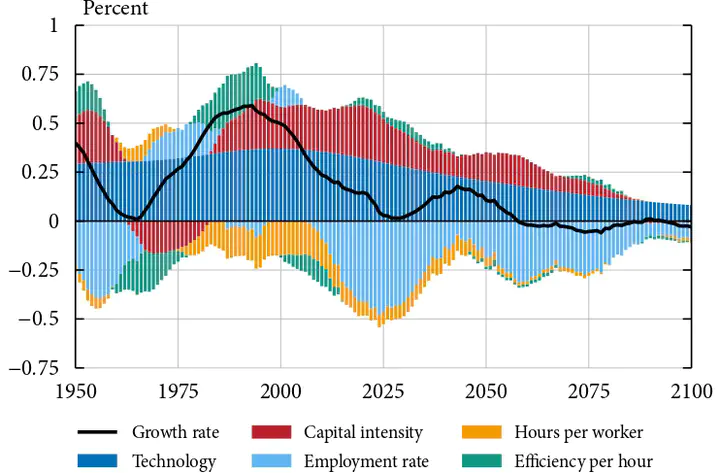 Growth impact of the demographic transition
Abstract
Does population ageing hurt output per capita? Standard life-cycle models with exogenous growth that emphasise two opposing forces, capital deepening versus declining employment rates, predict yes. Using a quantitative overlapping generations model with realistic demographics and R&D-driven endogenous growth, this paper challenges that prediction through a third channel: that ageing populations boost R&D investment and therefore generate technological progress. Calibrated to the United States, the model implies that the demographic transition between 1950 and 2100 increases annual per-capita growth by 0.33 percentage points until 2000 and by 0.16 percentage points overall, thereby accounting for 10 to 20 percent of observed US growth. These transitional growth effects cumulate into a permanently higher level of output per capita. The key mechanism is endogenous technological change, whose growth contribution triples that of capital deepening; shutting down this channel eliminates the positive impact altogether.